
First Nations Pedagogy Blog News, Announcements, Ideas
Guide to Acknowledging First Peoples & Traditional Territory03 Oct, 2017 | Posted by: june
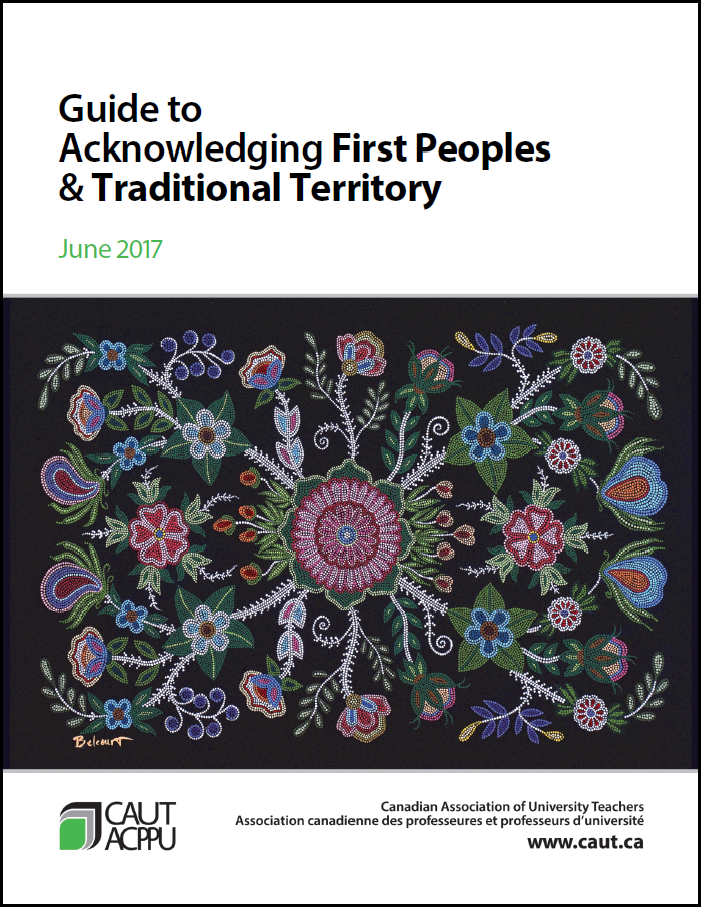
This document offers the Canadian Association of University Teachers (CAUT) recommended territorial acknowledgement for institutions where our members work, organized by province. While most of these campuses are included, the list will gradually become more complete as we learn more about specific traditional territories. When requested, we have also included acknowledgements for other post-secondary institutions as well.
We wish to emphasize that this is a guide, not a script. We are recommending the acknowledgements that have been developed by local university-based Indigenous councils or advisory groups, where possible. In other places, where there are multiple territorial acknowledgements that exist for one area or the acknowledgements are contested, the multiple acknowledgements are provided. This is an evolving, working guide.
VIEW AND DOWNLOAD THE GUIDE
Raven Medicine to Inspire You!02 Oct, 2017 | Posted by: june

"Looking behind I am filled with gratitude. Looking forwad I am filled with vision. Looking upwards I am filled with strength. Looking within I discover Peace.” ~Q’ero Proverb
Raven Art by Jody Bergsma
Four Directions Teachings - Beautiful Work!02 Oct, 2017 | Posted by: june

Four Directions Teachings celebrates Indigenous oral traditions by honoring the process of listening with intent as each elder or traditional teacher shares a teaching from their perspective on the richness and value of cultural traditions from their nation.
In honor of the timelessness of Indigenous oral traditions, audio narration is provided throughout the site, complimented by beautifully animated visuals. In addition, the site provides free curriculum packages for grades 1 to 12 to further explore the vast richness of knowledge and cultural philosophy that is introduced within each teaching. The curriculum is provided in downloadable PDF and can also be read online through the Teacher’s Resources link.
The elders and traditional teachers who have shared a teaching on this site were approached through a National Advisory Committee of Indigenous people concerned with the protection and promotion of Indigenous knowledge. This committee was formed directly for the purposes of this website to ensure a community based approach that was respectful and accountable.
VISIT THE FOUR DIRECTIONS TEACHINGS SITE
Incorporating Aboriginal Wisdom to promote Ecoliteracy Conference Presentation02 Oct, 2017 | Posted by: june
Presented at Teaching & Learning Symposium, Kwantlen Polytechnic University, June 7, 2017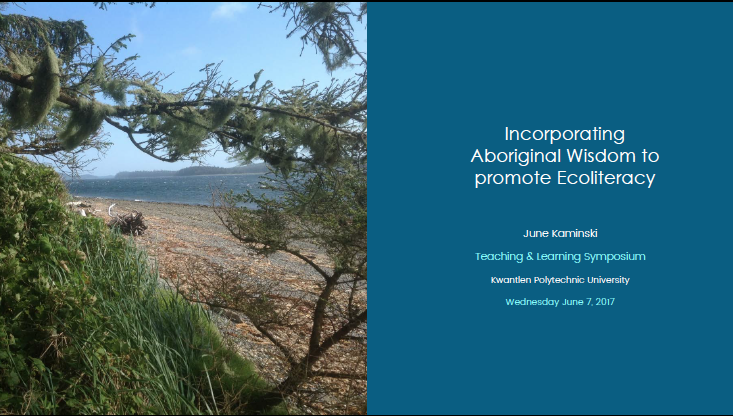
Abstract
Ecological sustainability is a goal of many Canadian organizations and professionals, including educators and students. The most logical source of sustainability wisdom that promotes ecological wholeness is traditional Aboriginal teachings and philosophies. Nursing educational programs are beginning to incorporate Aboriginal wisdom into curriculum to promote holistic nursing care of First Nations, Metis and Inuit people and to help evolve ecoliteracy. Nursing faculty follow a mandate to teach students to be active agents of advocacy for global issues including environmental health and ecology.
This presentation addressed how students create content to help nurses explore ecological issues and engage in the process of finding solutions to critical issues, and how Aboriginal wisdom supports this. It also explored how the Canadian Nurses for Health and the Environment encourages all Canadian nurses to become involved in promoting ecological sustainability on a national level.
The presentation supports the notion that all human beings must develop ecoliteracy if we are to preserve our earthly home. This requires both thought and definitive action to avert planetary crises and to preserve our environment for future generations.
VIEW THE PRESENTATION
Incorporating Aboriginal Wisdom to Promote Ecoliteracy 07 Apr, 2016 | Posted by: june
Ecological sustainability is a goal of many Canadian organizations and professionals, including nurses. The most logical source of sustainability wisdom that promotes ecological wholeness are traditional Aboriginal teachings and philosophies. Nursing educational programs are beginning to incorporate Aboriginal wisdom into curriculum to promote holistic nursing care of First Nations, Metis and Inuit people and to help evolve ecoliteracy. Nursing faculty follow a mandate to teach students to be active agents of advocacy for global issues including environmental health and ecology.
This Pechakucha by June Kaminski addresss how students create content to help nurses explore ecological issues and engage in the process of finding solutions to critical issues, and how Aboriginal wisdom supports this. It also explores how the Canadian Nurses for Health of the Environment encourages all Canadian nurses to become involved in promoting ecological sustainability on a national level.
Test Your Knowledge on GMOs27 Feb, 2014 | Posted by: june

Test Your Knowledge about GMOs with this 15 item online quiz by Wise Mind, Healthy Body